Left:
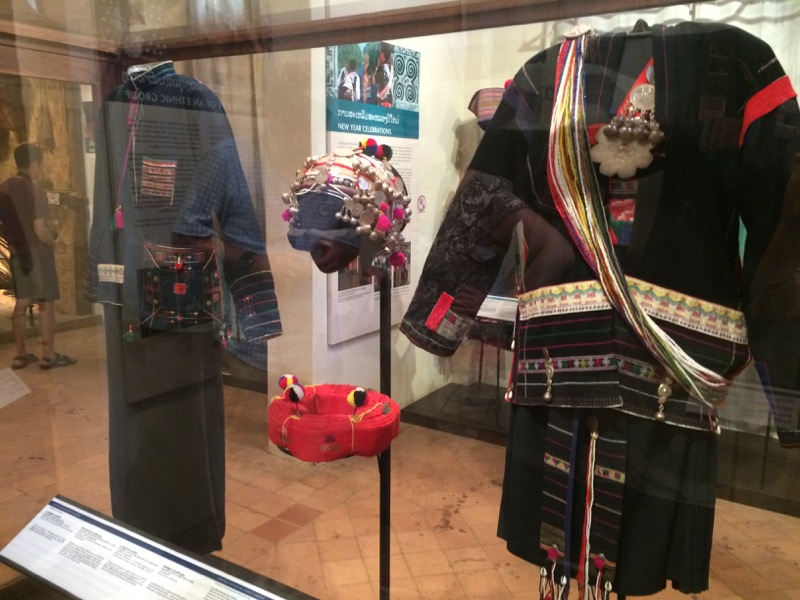
Set of Akha Pouly Nyai man’s clothing
Akha Pouly Nyai. Phiyer village, Luang Namtha Province
Handwoven cotton indigo-dyed shirt, trousers, and bag. Multicoloured embroidery and market-bought trim on shirt and bag. Hand sewn.
Though never as heavily adorned as the women, the shirts of wealthy men may also be decorated with silver coins and ornaments. Embroidery motifs often depict trees, birds or flowers.
Center top:
Akha Pouly Nyai woman’s headdress (ou tse)
Akha Pouly Nyai. Silver work by Soh Keu, 2007. Made by Long Sue, 2007. Phiyer village, Luang Namtha Province
Hand forged silver, handwoven cotton, factory-made cloth, plastic beads, bamboo, shells, yarn balls.
This headdress is made of 10 separate articles and over 300 silver ornaments assembled to create a striking headpiece which is the pride of an Akha woman. A woman gradually collects and earns silver for her headdress from about 12 years of age, using the local silversmith to pound coins into balls and flowers. Traditionally, women would wear their headdress even while bathing, sleeping and working in the fields.
Center bottom:
Akha Pouly Nyai man’s head wrap (ou zhong)
Akha Pouly Nyai. Made by Long Sue, 2007. Phiyer village, Luang Namtha Province
Factory-made cloth with embroidery, yarn.
To create this head wrap, a man must gather two or three of his friends to hold a long red cloth in a taut line. Then he holds one end of the cloth to his head while spinning down the line to form the layers.
Right:
Set of Akha Pouly Nyai woman’s clothing
Akha Pouly Nyai. Made by Long Sue, 2007. Silver work by Soh Keu, 2007. Phiyer village, Luang Namtha Province
Handwoven cotton indigo-dyed jacket (la sah), shirt (peh how), pleated skirt (phi di), belt (ze zhang), leggings (keu bong), bag (dzeuy zhong), necklace (yu mah).
Women wear their pleated skirts low on their hips and the inside shirt is fastened over one shoulder only. Women add silver coins and balls to their outfit when they can afford to, which is why some land owners find it easier to find labourers if they pay in indochinese coins rather than cash.